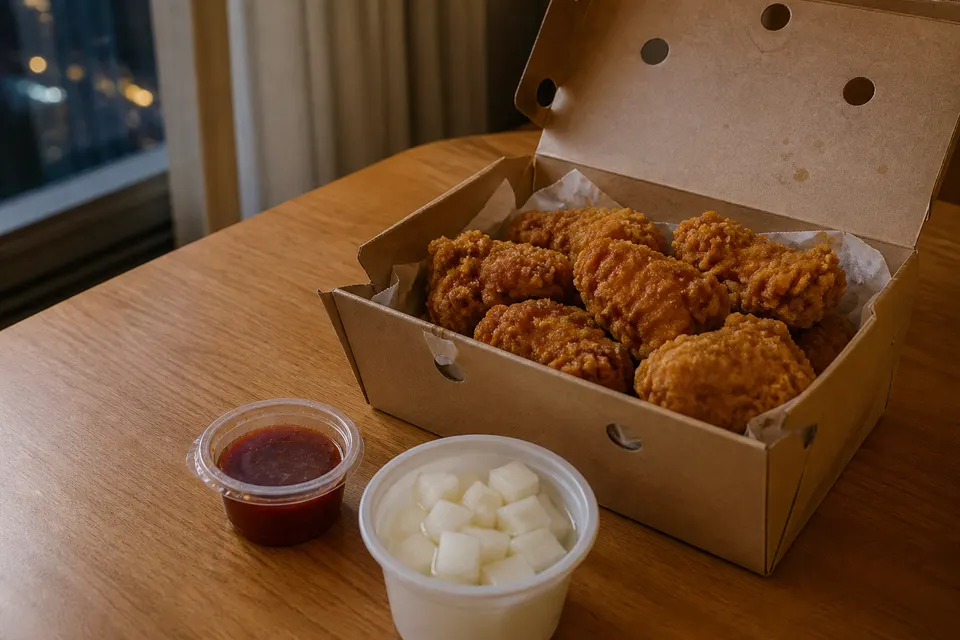
Start with the journey, not the most dramatic menu photo
Korean fried chicken is often introduced as a flavor catalogue: soy, sweet-spicy yangnyeom, garlic, cheese, green onion, or something new on a chain menu. Delivery adds another variable before you taste any of it. The chicken leaves a fryer, goes into a container, travels through a city, and arrives after the crust has been exposed to heat and moisture. Your first order should make that journey easy to understand.
That is why a plain fried order or a half-and-half order with sauce separated can be more useful than the most heavily coated specialty menu. You can taste the chicken and crust first, then add sauce in smaller amounts. This is not a claim that one style is universally better. It is a way to keep the first meal from hiding every difference under a single coating.
The Ministry of Food and Drug Safety's chicken delivery guidance gives the kitchen side of the same idea: fried chicken should be cooled enough to remove hot steam before it is quickly provided or packed. The guidance is written for food businesses, not home tasting, but it explains why packaging and timing belong in the order decision. Texture is partly a recipe question and partly a handoff question.
Choose by the texture you want to preserve
If your priority is a crisp first bite, begin with 후라이드 or a lightly seasoned fried style and keep the sauce separate. If your priority is a glossy, sweet-spicy coating that clings to every piece, 양념 is the more direct choice. If you are sharing with someone who wants both, 반반 is the compromise, but ask how the two styles will be packed. The useful question is not ‘Which flavor is best?’ It is ‘Which texture do I want to still notice when the box arrives?’
Bone-in and boneless are also experience choices. Bone-in pieces can make a shared meal slower and messier, but they give you familiar visual markers such as wings, drumettes, and larger pieces. Boneless is easier to divide, especially for a first order at a desk or in a hotel room. Neither option is a reliable shortcut to quality: the Korea Consumer Agency's chicken comparisons show that product weight, piece size, coating, sensory characteristics, and nutrition can vary across samples.
That consumer comparison is a useful guardrail, not a restaurant ranking. Its measurements apply to the products tested, not to every Korean delivery shop. Use the finding as a reason to read the specific menu, portion description, and price shown at checkout. Avoid turning ‘boneless’ into a promise of tenderness or ‘bone-in’ into a promise of better flavor.
Use the handoff as part of the order
Before ordering, compare the estimated delivery time with the distance and the moment you can actually eat. A fifteen-minute delay may matter more to plain fried chicken than to a sauced dish, while a long ride can change both temperature and crust. Estimates are not guarantees, so the goal is not to find a magical number. It is to avoid ordering a delicate texture when you know the handoff will sit unattended.
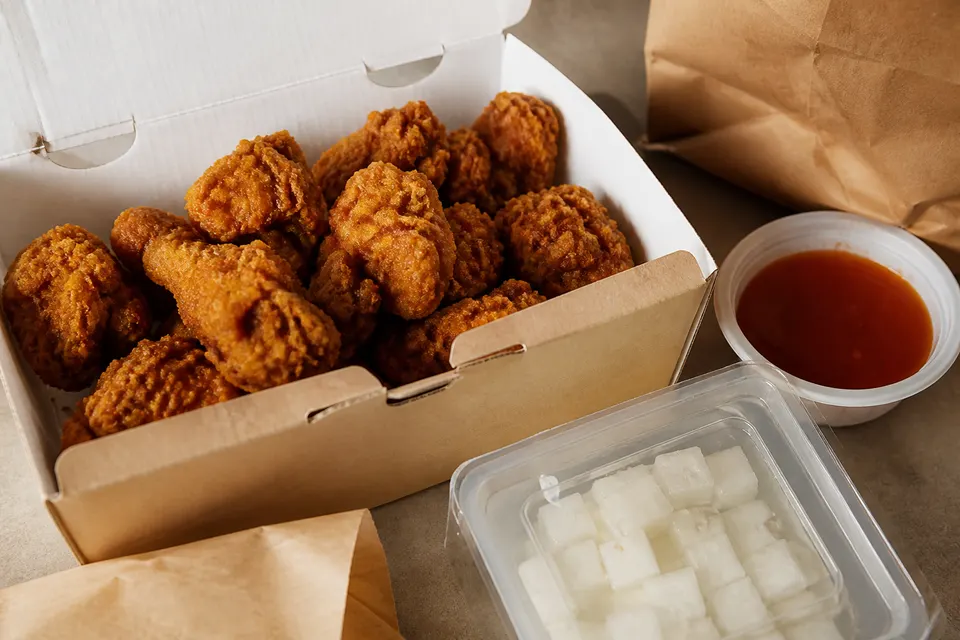
When the box arrives, check the simple things first: Is the package sealed? Are the sauce and sides intact? Is the food still arranged rather than crushed? A good-looking box is not proof of safe handling, but a damaged or leaking package is a reason to pause and contact the restaurant or platform. The MFDS guidance calls for food-grade delivery containers and separate management of sauces, pickled radish, and vegetables, including appropriate refrigerated storage before use.
Open the box soon after arrival. If the lid is tightly closed, trapped steam can soften a crisp coating; if the food is already sauced, that softening may be part of the intended style. Do not treat this as a home safety test or a way to reverse a long delay. It is simply the fastest way to see what you actually ordered while the restaurant and platform details are still easy to check.
Based on: Ministry of Food and Drug Safety · Chicken Delivery Restaurant Hygiene Guidelines · Korea Consumer Agency · Franchise Chicken Quality Comparison
Do not use the star rating as your only evidence
Reviews help you discover vocabulary, portion expectations, and recurring problems, but a high score is not a controlled quality measurement. The Korea Consumer Agency's review-practice study found that review-event incentives can distort restaurant ratings and that platform guidance around reviews can be insufficient. A shop's star average may describe a mix of food, speed, service, packaging, and promotional behavior rather than the exact menu you are considering.
Read recent written reviews for concrete signals instead. Look for repeated mentions of sauce arriving separately, missing sides, crushed pieces, long delays, or a menu option that differs from the photo. Treat one dramatic review as an anecdote and repeated, specific observations as a prompt for a second check. Do not copy a reviewer's wording into your own expectations; use it to form a question.
This is also where a local Korean source is useful but limited. A domestic guide can show how people navigate delivery and pickup categories, yet it cannot verify today's price, every neighborhood's delivery time, or the kitchen's current packing practice. The article's practical rule is simple: use local content to learn how the system is described, then verify the live menu and order screen yourself.
Build a first order that teaches you something
For one person, choose a modest fried chicken portion with sauce on the side, Korean pickled radish, and no more than one extra side. This gives you a clean comparison between crust, meat, sauce, and the cold acidic bite of 치킨무 (chikin-mu), without making the box a survey of every category. For two or more people, a half-and-half order can work if everyone agrees that the two styles may arrive with different textures.
If you are in Korea briefly and cannot read the app comfortably, use the restaurant's menu photos only as a starting point. Confirm the Korean words for fried, sauced, boneless, bone-in, delivery, and pickup. Save a screenshot of the final order details, including options and estimated time. The point is not to create a perfect record; it is to prevent a translation shortcut from changing the meal without you noticing.
The order becomes more informative when you change one variable at a time. On a later meal, compare the same shop's plain fried and sauced versions, or compare delivery with pickup if both are available. That produces a more useful personal answer than jumping between brands, sauces, portion sizes, and delivery distances at once.
ORDER BY THE HANDOFF
Four decisions that protect the first bite
The order is a sequence: choose what travels well, separate what should stay separate, then check the handoff before you judge the food.
- 01
1 · READ 메뉴 읽기
Find 후라이드, 양념, 순살, 뼈, 반반, 소스 별도, 배달, and 포장.
- 02
2 · MATCH 시간 맞추기
Choose a delivery estimate and distance that fit when you can eat.
- 03
3 · SEPARATE 분리 포장
Prefer sauce and cold sides in their own containers when crispness matters.
- 04
4 · CHECK 도착 확인
Inspect the seal, sides, and condition before deciding whether the menu traveled well.
Based on: Ministry of Food and Drug Safety · Chicken Delivery Restaurant Hygiene Guidelines · Korea Consumer Agency · Franchise Chicken Quality Comparison · Korea Consumer Agency · Delivery Platform Review Practices · Born in Korea · How to Use Korean Food Delivery Apps
A first-order checklist
Before payment: confirm the address in Korean, check whether the menu is delivery or pickup, read the estimated time, and decide bone-in or boneless. If you want the crust to stay distinct, choose plain fried or sauce on the side. If a menu offers 반반, check which two flavors are included rather than assuming the photo represents the exact combination.
At the door: check the seal and the separate containers, then open the main box soon after arrival. If an item is missing or the package is damaged, photograph the order while the issue is visible and use the platform or restaurant's support flow. Keep the source guidance in perspective: a public hygiene guideline explains the controls businesses should use, but a customer cannot certify the kitchen by looking at one box.
After the first bite: note three things only—how the crust traveled, whether the sauce matched the menu description, and whether the portion fit the group. Those observations will help you choose the next order. A star rating without those details will not.