ORDERING FIELD GUIDE
Six rolls, six different ways to read a Korean menu
Start with the filling and the serving style, not with the assumption that every gimbap tastes the same. These six entries cover the rolls a first-time visitor is most likely to see, plus the clues that make each one distinct.
01 · THE BASELINE
Everyday gimbap
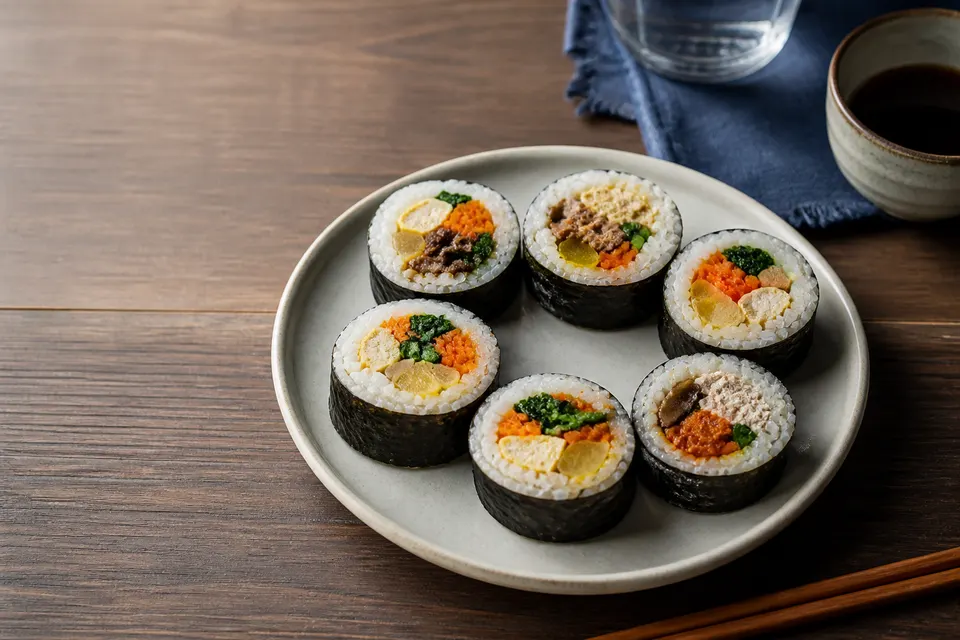
The familiar starting point: seasoned rice and a cross-section of vegetables, egg, pickled radish, and often ham or burdock rolled in gim.
- LOOK FOR
- A balanced stripe of fillings rather than one dominant centerpiece.
- ORDER WHEN
- You want to understand the basic gimbap vocabulary before trying variations.
Based on: Korea.net · Gimbap: The Evolution of Korea’s Rolled Rice Dish · Korean Culture Box · Gimbap · VISITKOREA · Gimbap
02 · THE SAVORY ONE
Tuna gimbap
Tuna becomes the main note, usually surrounded by the same crunchy, salty, and fresh elements that keep the roll from feeling one-dimensional.
- LOOK FOR
- A pale tuna filling, often mixed with mayonnaise, alongside perilla or vegetables.
- ORDER WHEN
- You like a richer, savory center but still want the contrast of a cold or room-temperature roll.
Based on: Korea.net · Gimbap: The Evolution of Korea’s Rolled Rice Dish · VISITKOREA · Exploring the Latest Gimbap Trends in the Birthplace of Gimbap
03 · THE MEATY ONE
Bulgogi gimbap
Thinly sliced, seasoned beef gives the roll a warmer, sweeter-savory center while egg, carrot, cucumber, perilla, and pickled radish keep the cross-section busy.
- LOOK FOR
- A dark, glossy strip of beef running through the middle of the roll.
- ORDER WHEN
- You want a filling lunchbox-style roll with a clear beef flavor rather than a seafood filling.
Based on: VISITKOREA · Bulgogi Gimbap
04 · THE COASTAL SPECIALTY
Chungmu gimbap
This Tongyeong specialty keeps the roll itself simple: plain rice wrapped in gim, served beside seasoned squid and radish kimchi rather than packed into the center.
- LOOK FOR
- Small plain rolls arriving with separate, strongly seasoned side dishes.
- ORDER WHEN
- You want to taste the difference between a filled roll and a roll designed to be eaten with its accompaniments.
Based on: Korea.net · Gimbap: The Evolution of Korea’s Rolled Rice Dish
05 · THE INSIDE-OUT LOOK
Nude gimbap
The rice sits on the outside and the gim wraps the fillings inside, reversing the visual order most diners expect from a standard roll.
- LOOK FOR
- A pale rice surface on the outside, with the seaweed appearing as an inner band.
- ORDER WHEN
- You want a textural variation or a roll that photographs differently from the standard cross-section.
Based on: Korea.net · Gimbap: The Evolution of Korea’s Rolled Rice Dish
06 · THE VEGETABLE ROUTE
Vegetable and seasonal gimbap
Vegetable gimbap makes the filling itself the point, while newer versions may bring in ingredients such as buckwheat or other locally available produce.
- LOOK FOR
- A roll built around greens, roots, mushrooms, or another named vegetable rather than ham or tuna.
- ORDER WHEN
- You want to compare how the roll changes when the filling is the headline instead of a supporting stripe.
Based on: VISITKOREA · Gimbap · VISITKOREA · Exploring the Latest Gimbap Trends in the Birthplace of Gimbap
First, drop the sushi comparison
Gimbap is made by spreading rice and ingredients on gim, Korean laver, then rolling and slicing it into bite-sized pieces. That construction is why people often compare it to sushi. The comparison can help a reader picture the shape, but it stops being useful if it makes you expect raw fish, vinegar-seasoned rice, or one fixed set of fillings.
The rice, the seasoning, the cooked fillings, and the way the roll is served belong to gimbap’s own everyday food culture. Korea.net describes it as a lunchbox and casual-dining food, while the Korean Culture Box recipe shows how the familiar version is assembled from seasoned rice, spinach, carrot, beef, egg, and pickled radish.
The cross-section is a menu, not decoration
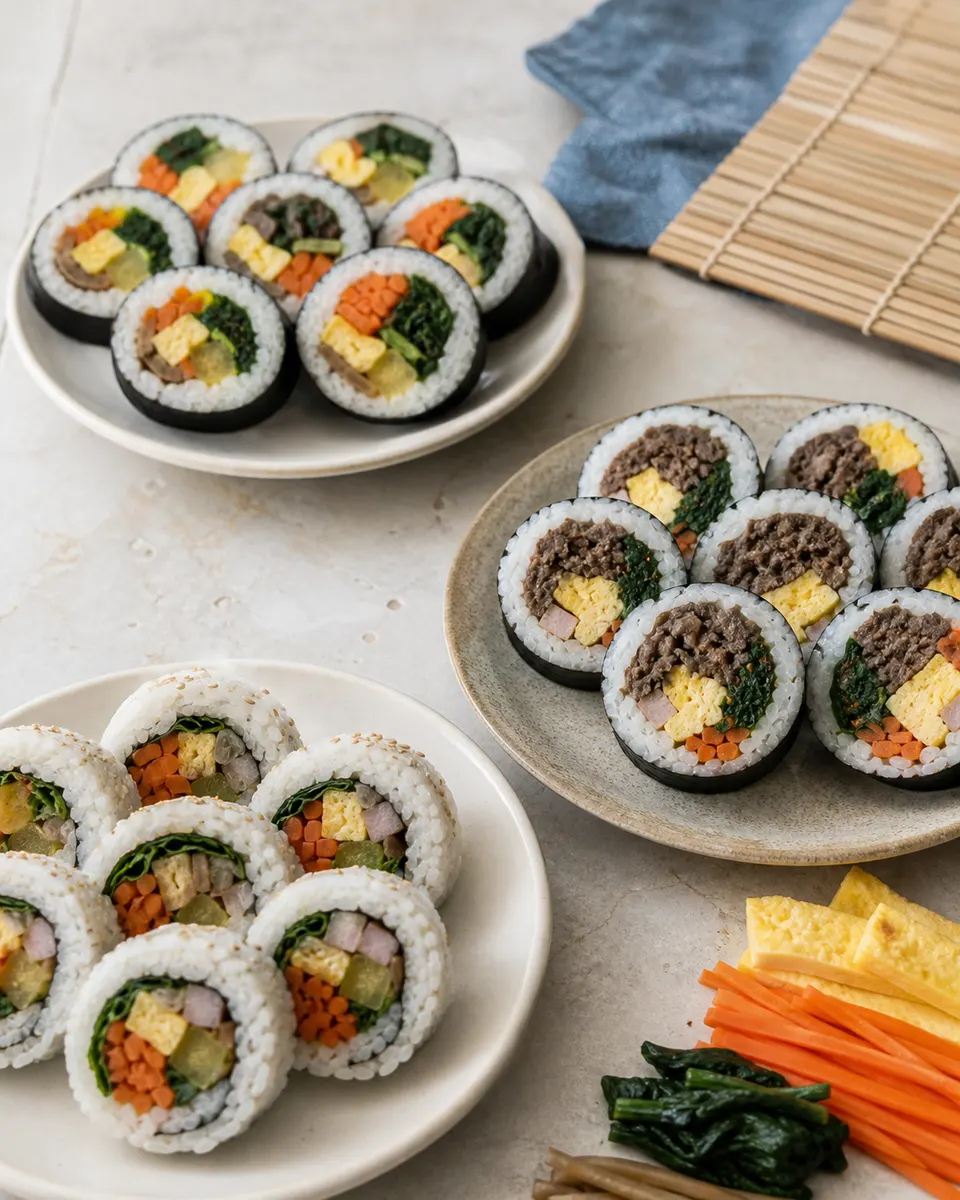
Once the roll is sliced, the filling tells you how the cook wants you to eat it. A basic gimbap gives you several small contrasts in one bite. Bulgogi makes beef the anchor. Tuna changes the center without changing the basic architecture. Nude gimbap changes the order of the layers, while Chungmu gimbap changes the relationship between the roll and its side dishes.
This is why a menu name can be more helpful than a photograph. The word before gimbap often tells you what to look for first: the protein, the vegetable, the region, or the construction. If the name is unfamiliar, ask for the filling rather than asking whether it is spicy.
Based on: Korean Culture Box · Gimbap · VISITKOREA · Gimbap
A simple ordering strategy
For a first visit to a gimbap shop, choose one baseline roll and one clearly different version. Pair everyday gimbap with Chungmu if you want to compare a packed roll with a separated serving style, or choose bulgogi if you want the filling to be immediately legible. The point is to compare structures, not to collect six nearly identical slices.
Gimbap also travels well as a picnic or quick meal, which is part of why it appears in so many ordinary Korean food settings. Order it as food for a route, a lunch break, or a shared table. The most useful question is not ‘Which roll is the authentic one?’ but ‘Which filling or serving style do I want to understand next?’
What to order alongside the roll
Gimbap is often part of a casual meal rather than a standalone tasting plate. Korean food coverage commonly places it beside noodle soups such as ramyeon or udong, and some gimbap shops offer broth as a simple companion. The logic is practical: a warm, savory broth changes the pace of a meal built around cool rice and crisp fillings.
Tteokbokki is another familiar pairing. VISITKOREA describes dipping gimbap in the spicy sauce, which turns the roll into a carrier for a stronger chili flavor. You do not need to order every side dish at once. For a first meal, one roll plus a bowl of broth is enough to understand the format; add tteokbokki when you want heat and a softer, saucier contrast.
A US reader’s shortcut for choosing a first roll
If you are starting from the United States, the most accessible entry point is usually a Korean restaurant, a Korean grocery prepared-food counter, or a frozen-gimbap section. Availability and ingredients vary by store, so treat the label as a guide rather than assuming that every vegetable roll is vegetarian or that every tuna roll uses the same sauce. Ask what is inside when sesame, egg, fish, shellfish, or meat matters to you.
For a first comparison, choose everyday gimbap and bulgogi gimbap if you want familiar vegetables with a clear beef center. Choose vegetable gimbap and nude gimbap if you want to focus on texture and construction. The best first order is not the most elaborate one; it is the one that lets you identify what changed from one bite to the next.