Three words, one familiar street-food scene
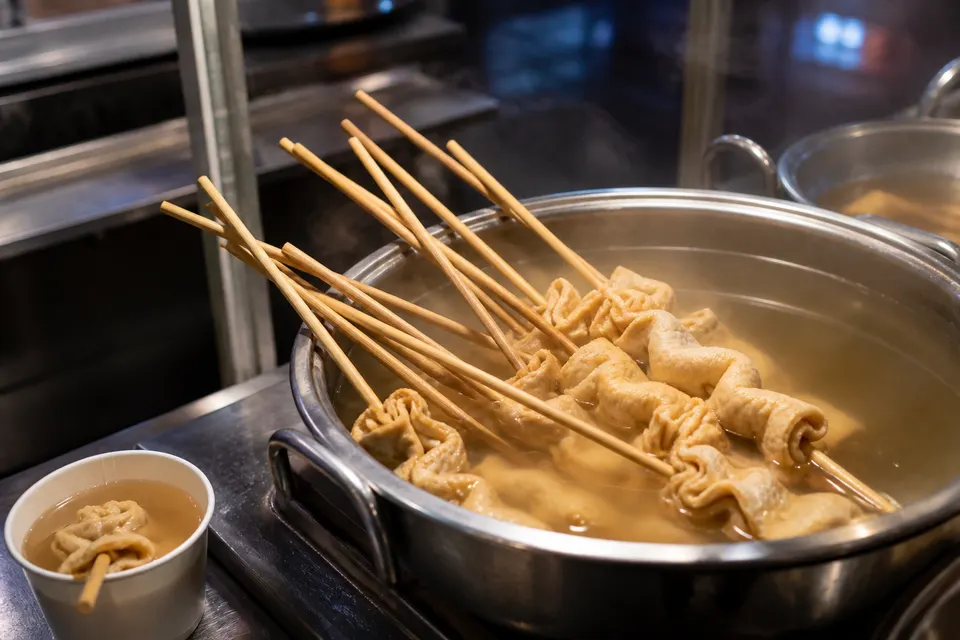
If you have seen a Korean street-food stall, you have probably seen eomuk: pale or golden fish cakes folded, rolled, or pierced on long skewers and kept warm in a clear broth. The confusion begins when menus use more than one name for the same scene. Eomuk is the Korean term for the fish-cake product. Odeng is a widely recognized name for the street snack and its Japanese-influenced vocabulary. Eomuk-guk, or eomuk soup, puts the broth and the bowl into the foreground.
These labels are not three unrelated foods. They are a useful map of emphasis. Say eomuk when you are talking about the ingredient or category. Say odeng when a casual menu or vendor uses that familiar label for skewered street food. Look for eomuk-guk when you want the soup itself, usually with fish-cake pieces and a hot, savory broth. The exact wording varies by shop, so the cooking vessel and serving style still matter.
What is eomuk made from?
VISITKOREA describes eomuk as seasoned fish fillet that is shaped and cooked, while its food entry identifies white-flesh fish such as yellow croaker as a common base. Korea.net’s account adds the practical production idea: fish meat is pureed, seasoned, and processed into a product that can be steamed, fried, broiled, or simmered. In other words, eomuk is not one fixed shape and it is not simply a fish-shaped version of a meatball.
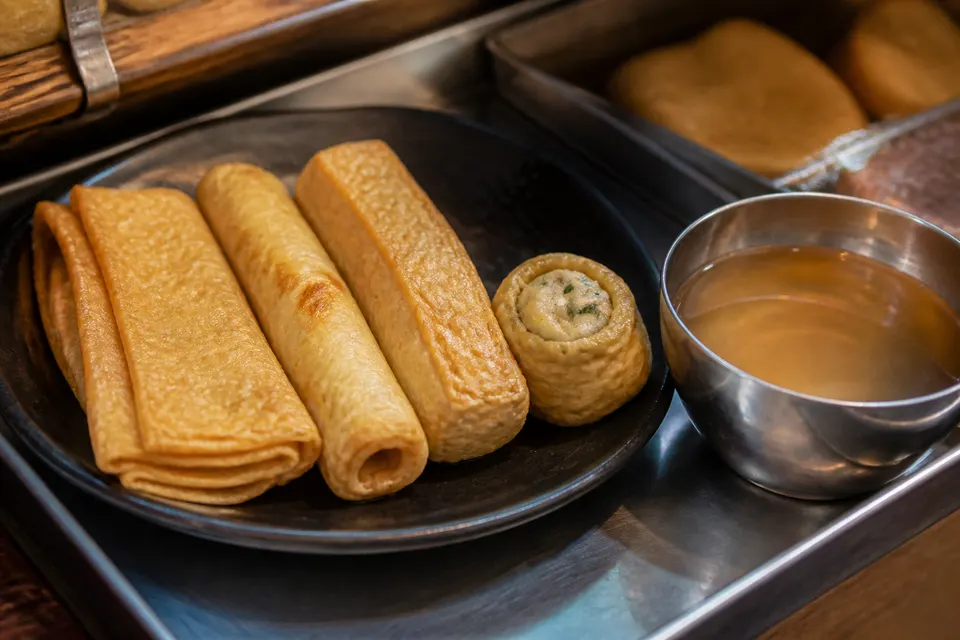
The finished texture depends on the fish mixture, the amount of water or starch, the shape, and the cooking method. A thin sheet can pick up broth quickly. A thicker bar can feel springier. A product filled or mixed with vegetables, seafood, cheese, or other ingredients may read more like a snack on its own. That range is why a shop can display many forms of eomuk without changing the category.
For a US reader, ‘Korean fish cake’ is a useful translation but an incomplete expectation. It tells you the base, not whether the piece will be soft, bouncy, crisp-edged, spicy, stuffed, or soaked in broth. The Korean name keeps the category open until you see the shape and the way it is served.
Eomuk vs. odeng: what changes on the menu?
In everyday Korean food writing, eomuk and odeng can refer to the same general family of fish-cake street food. Korea.net explicitly uses the pair ‘odeng or eomuk’ for fish-cake skewers served in warm broth. That is the reason a visitor may hear one word from a local vendor and see the other on a sign without encountering two completely different dishes.
There is still a difference in what the words suggest. Eomuk is the neutral Korean category name and the safer term when you want to talk about the ingredient. Odeng carries the familiar street-stall association and can sound more like the ready-to-eat snack. Neither word tells you the exact fish, shape, seasoning, or price. If those details matter, use the label as an opening question rather than a full product description.
A good menu-reading habit is to pair the word with the visual cue. Is it folded into a flag shape, rolled around a skewer, cut into a cup, fried like a croquette, or served in a bowl? The form is often more useful than an English translation because it tells you how the vendor expects you to eat it.
READ THE LABEL
Three names, three points of emphasis
The words overlap in everyday use, but each one helps you ask a different question at the counter.
- 01
Eomuk 어묵
The Korean category name for the fish-cake product.
- 02
Odeng 오뎅
A familiar street-food label often used for skewers and broth.
- 03
Eomuk-guk 어묵국
Fish cake served as soup, with the broth part of the order.
Based on: Korea.net · Fish cake: a must-eat snack · VISITKOREA · Fishcake (Eomuk)
Eomuk-guk is the broth-centered version
Eomuk-guk, also written eomuktang in some contexts, is where the broth becomes part of the order rather than a background detail. VISITKOREA describes skewered fish cakes simmered in a broth made with anchovies and radish, often eaten with soy sauce. Korea.net describes eomuktang as a soup containing differently shaped fish cakes, vegetables, and other additions. The common thread is not a single standardized recipe; it is the hot liquid, the skewer, and the pause around the pot.
At a street stall, the broth may arrive in a paper cup alongside a skewer. At a restaurant, the same idea may appear as a bowl or a shared pot. The serving format changes the pace: a cup is a quick stop between errands, while a bowl gives the fish cake and broth more room to function as a meal or a side order.
The flavor is usually gentler than the red sauce associated with tteokbokki. That makes eomuk-guk a helpful first order for someone who wants to understand the fish cake before adding strong chili heat. Try the broth first, then dip or season the fish cake according to the stall’s condiments.
Why Busan is the city most associated with eomuk
Busan’s connection to eomuk is more than a tourism slogan. The port city’s seafood economy, markets, and long fish-cake manufacturing tradition helped make the food part of its everyday identity. VISITKOREA highlights Busan’s fish-cake variety and points visitors toward local shops such as Samjin Fish Cake and Goraesa. The city’s official archive describes Busan eomuk as a regional food made from fish meat and recognized as a piece of local heritage.
The important distinction is between a place association and a guarantee. A product called Busan eomuk is not automatically identical to every fish cake sold in Busan, and a Seoul or Los Angeles restaurant can serve its own version. What Busan gives the category is a strong regional story: fresh seafood access, specialized producers, market culture, and a recognizable range of shapes and flavors.
If your trip includes Busan, eomuk is an efficient food to add to a market walk because it connects the city’s port identity to a practical snack. You do not need a ranked list of brands to understand the tradition. Compare one plain skewer with one filled or shaped piece, then notice how the broth changes the experience.
Based on: VISITKOREA · Fishcake (Eomuk) · Busan Metropolitan City · Busan Eomuk Future Heritage
Why the food feels especially Korean in winter
Eomuk is available beyond winter, but the cold season makes its design obvious. A skewer is easy to hold, the broth gives immediate warmth, and the stall works as a short stop rather than a full sit-down meal. VISITKOREA’s winter food coverage places eomuk beside other cold-weather snacks and frames the choice around how much food and broth a visitor wants, not around a single correct way to eat it.
That context matters for readers who first meet eomuk through Korean television. The steam, paper cup, and shared counter are not just visual shorthand for ‘Korean food.’ They describe an actual eating situation: a small, hot, inexpensive pause in a public place. The scene can be recreated in a restaurant, but it is easiest to understand when you notice the weather, the queue, and the broth together.
In the United States, you may find eomuk in Korean restaurants, grocery-store prepared-food counters, frozen aisles, or menus that use ‘fish cake’ without the Korean name. Ask whether the item is served in broth, fried, or mixed into another dish. That question will usually tell you more than the translation alone.
A first order that lets you compare the names
For a first taste, choose one skewered eomuk or odeng and eat a little of it before adding sauce. Notice the texture and the fish flavor. If a broth is available, take a sip separately. Then compare the experience with eomuk-guk or with a different shape from the same counter. This keeps the order small while giving you the two things the vocabulary is trying to separate: the product and the way it is served.
Useful menu words include 어묵 (eomuk), 오뎅 (odeng), and 어묵국 (eomuk-guk). A simple Korean request is ‘어묵 하나 주세요’ (one eomuk, please). If you want the soup, point to the bowl or say ‘어묵국 하나 주세요’ (one eomuk soup, please). Pronunciation does not need to be perfect; the menu and the skewer will do most of the work.
The shortest version is this: eomuk names the fish cake, odeng is a familiar street-food label that often overlaps with it, and eomuk-guk makes the broth the point. Start with the shape in front of you, ask how it is served, and let Busan’s fish-cake tradition lead you to the next bite.