Start with two layers, not one translation
Chuseok is commonly translated as Korean Thanksgiving, and the comparison is useful as a first doorway. Both holidays can bring relatives together around food, travel, memory, and a seasonal sense of abundance. The translation becomes misleading when it suggests that Chuseok is only a dinner or that every family keeps the same ceremony.
Think of Chuseok as the wider holiday and charye as one memorial practice that may happen during it. The National Folk Museum of Korea defines charye as a memorial service for ancestors held on major traditional holidays such as Chuseok and Seollal. That distinction gives you a better reading tool: a holiday can include a memorial table, family visits, food preparation, rest, travel, and many choices that never appear in a ritual diagram.
Recognize the table by its signals
Songpyeon is the fastest Chuseok food cue. These half-moon rice cakes are associated with the holiday and may be made in different colors and fillings. On a charye table, however, songpyeon is not just dessert. It can stand in for the seasonal food that belongs to this holiday, alongside the table's other offerings.
Look for layers rather than a fixed shopping list. A formal table can include rice, soup, rice cakes, fruit, meat, fish, jeon, vegetables, sweets, and liquor. Korea.net's explanation of the Chuseok charye table describes directional placement and rows of food, while the National Folk Museum explains the table as part of a longer service. Those sources help you notice the table's structure without turning one published arrangement into a household law.
READ THE TABLE
Three visual cues, one careful caveat
These original editorial illustrations separate the food signal, the formal table, and the memory carried through a household setting.
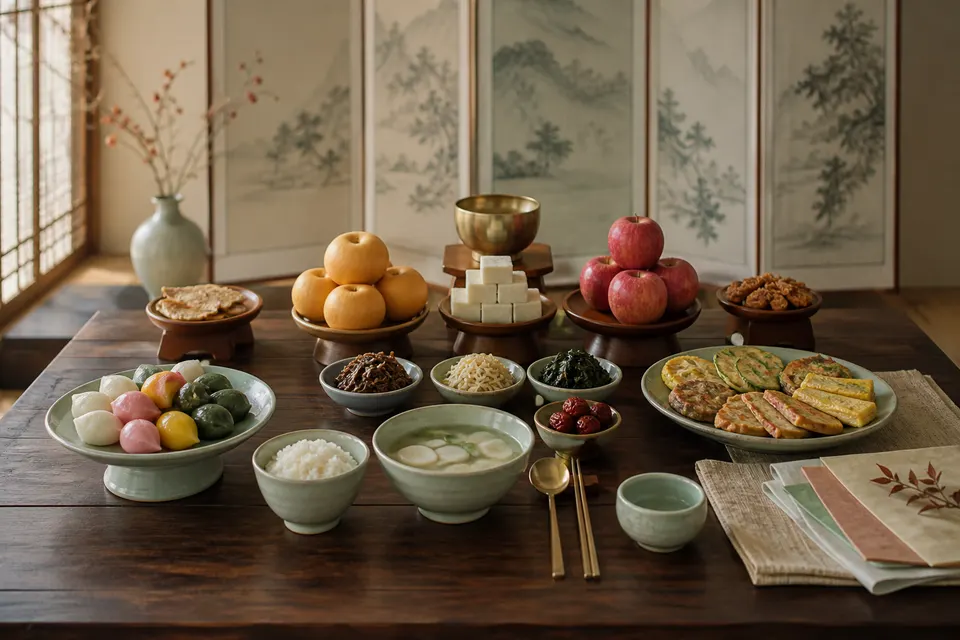
Songpyeon and seasonal foods make the holiday visible, but the table is more than a menu. AI-generated editorial illustration; not documentary evidence. visual only; does not depict a specific family, current ceremony, or universal table arrangement 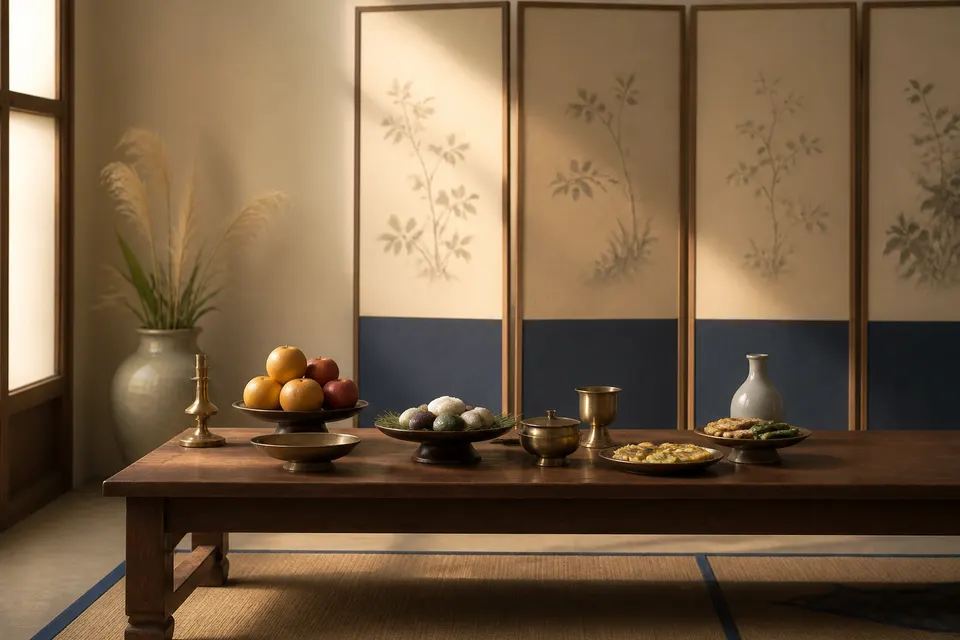
Formal arrangements exist, but household practice can leave room for variation. AI-generated editorial illustration; not documentary evidence. visual only; does not depict a specific family, current ceremony, or universal table arrangement 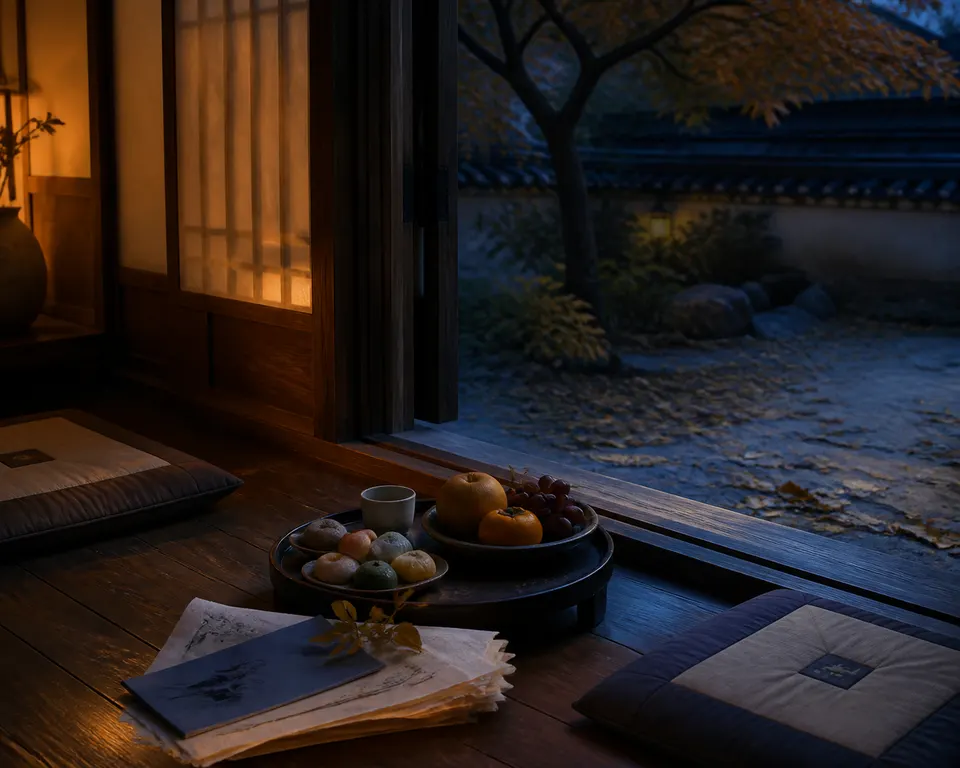
The holiday also carries memory, conversation, and the choices a family makes together. AI-generated editorial illustration; not documentary evidence. visual only; does not depict a specific family, current ceremony, or universal table arrangement
1 / 3
Original AI-generated editorial illustrations. They clarify cultural layers and do not document one family's current Chuseok table.
Source: National Folk Museum of Korea · What is Charye? · Korea.net · 2025 Chuseok Family Festival and Charye Table · Korea.net · Chuseok customs change with passage of time
Understand what charye is doing
The table is not simply a holiday buffet. Charye is a way to remember and honor ancestors, with food and drink placed as offerings and participants making formal bows. The exact sequence can be elaborate: arrangements are prepared, the service begins, offerings are presented, participants step away for a short period, and the table is eventually cleared. The point is relationship and remembrance, not a performance for an outside audience.
That is why the food can look familiar and still carry a different logic. Korea.net notes that rice and soup may be replaced by songpyeon at Chuseok, and that some table placements differ from everyday dining etiquette because the table is directed toward the ancestral world. Read those differences as signs of ritual context. They are not instructions for how every Korean meal works.
 WATCH ON YOUTUBEChuseok, Korean Thanksgiving Day
Open embedded player
Source: YouTube · Koreanet · Chuseok, Korean Thanksgiving Day
Make room for households that adapt
A formal charye table can take time, labor, money, and coordination. Families may live far apart, have different beliefs, work through the holiday, or decide that a shorter remembrance fits their situation better. Korea.net has documented changes in Chuseok customs over time, including households adjusting how they prepare food and perform rites. The direction of change is not one simple story of tradition disappearing; it is a story of practice being negotiated.
When you hear that a family does not perform charye, do not treat that as a contradiction of Chuseok. When you see a family perform it, do not treat that table as proof of a single Korean norm. Ask which parts matter to that household: cooking together, visiting a grave, bowing at home, sharing stories, traveling, or simply making time for relatives. The answer is often more informative than a claim about what Koreans always do.
Use the table as an invitation to ask better questions
If you are invited into a Chuseok setting, begin with observation and let your host explain the parts that matter. You can ask what a dish is, who prepared it, or whether the table is for a memorial service or a family meal. Avoid reaching across the table to correct an arrangement based on a diagram you saw online. The family in front of you is the best source for what this version means.
The useful takeaway is not a perfect five-row table. It is a habit of reading context. Songpyeon can signal the holiday. Charye can signal ancestor remembrance. A table's arrangement can show ritual logic. A shortcut, omission, or adaptation can show the life of a current household. Hold all four signals at once and Chuseok becomes easier to understand without becoming smaller than it is.