First, separate jeon from the English word pancake
At a Seoul market or Korean restaurant, the word pancake can make a US diner imagine a sweet, fluffy breakfast. Jeon points somewhere else. It is a broad Korean food family in which ingredients are coated, layered, or mixed with a flour, starch, egg, or mung-bean batter and pan-fried in oil. Some are thin and delicate; others are thick, rough-edged, and substantial. The shared idea is the hot pan and the savory ingredient, not one universal shape.
The Korean Food Promotion Institute’s overview places jeon in both everyday and ceremonial settings, including feasts, holidays, banquets, and drinking tables. That range explains why the same menu category can contain fish, beef, shellfish, vegetables, tofu, kimchi, or mung beans. For a first order, treat jeon as a format, then read the ingredient in front of it. The ingredient is usually the most reliable prediction of flavor and texture.
Pajeon is the scallion-led, savory pancake
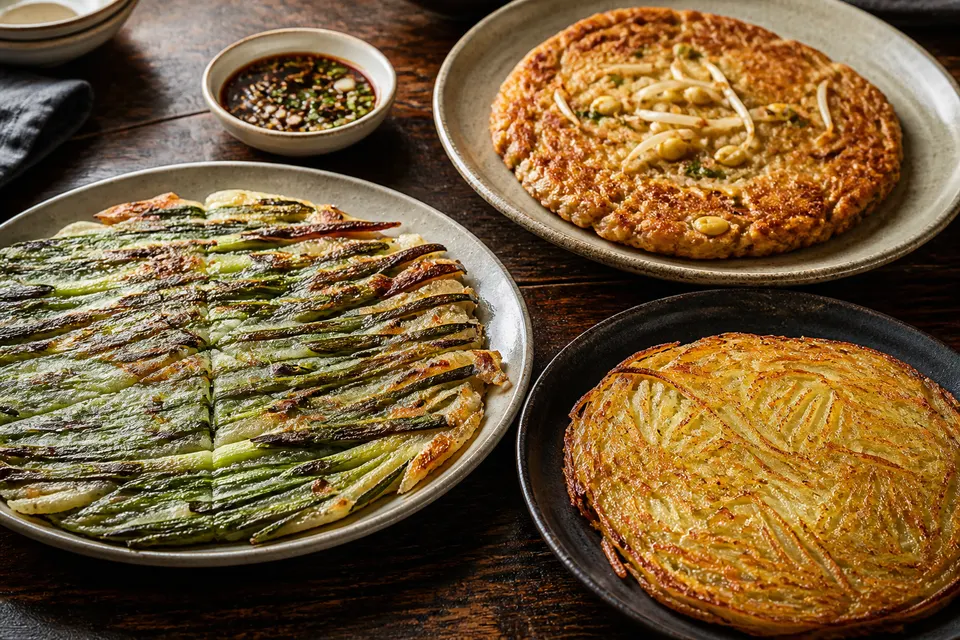
Pa means green onion, so pajeon is the easiest name to decode: scallions are the main event. The batter is spread in a pan, the long green onions are arranged across it, and other ingredients may be added between the layers. The Korean Food Promotion Institute’s version includes scallions, onion, red chili, flour, water, egg, and oil. A restaurant may make it thinner and crispier, softer in the middle, or generous with vegetables depending on its house style.
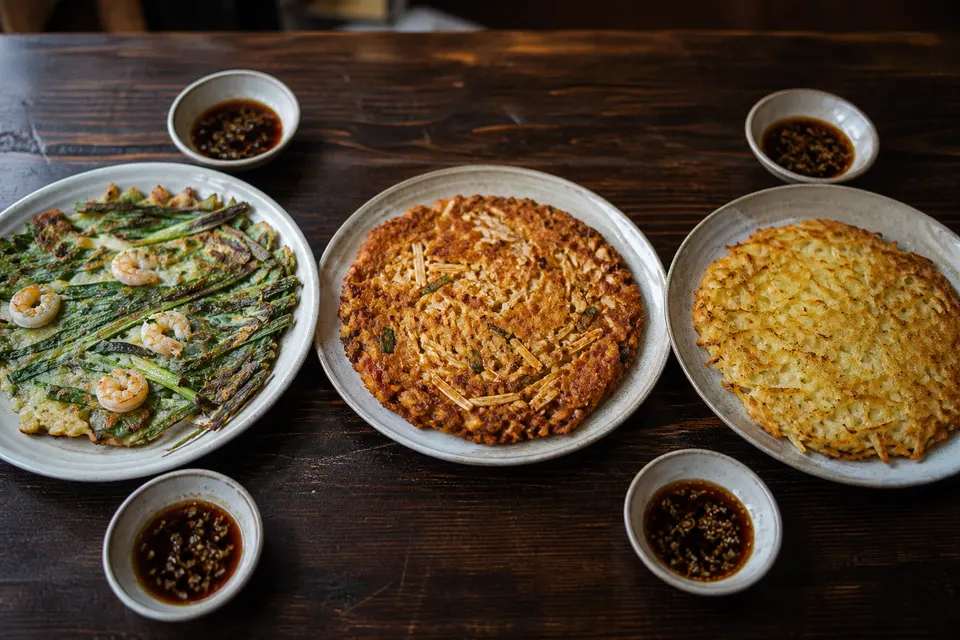
Haemul-pajeon adds seafood such as shrimp, squid, oysters, or mussels. That version is especially useful for US readers because the seafood changes the dish from a simple green-onion fritter into a larger shared appetizer. Ask whether the menu means plain pajeon or haemul-pajeon, and check whether the batter contains egg. The dipping sauce is usually soy-based and sharp enough to cut through the oil, so use it as seasoning rather than pouring it over the whole pancake.
Bindaetteok is thicker, earthier, and mung-bean based
Bindaetteok is sometimes translated as mung-bean pancake, but the translation does not fully prepare you for its texture. VISITKOREA describes a batter made from finely ground mung beans with pork, mung-bean sprouts, and bracken. The result is thicker and more savory than many flour-based jeon, with vegetables embedded in a coarse, hearty interior and a browned surface from the oiled pan.
This is the jeon most associated with the food stalls of Gwangjang Market in Seoul, but the important lesson is not to turn one market into the definition of the dish. Korea.net and VISITKOREA both describe bindaetteok as a mung-bean-based food that appears in many restaurants and market settings. Order it when you want something filling and deeply savory. It is a better choice for sharing than for a delicate first bite, especially when the menu serves it hot from a large griddle.
Gamjajeon is the mild potato option
Gamjajeon takes a different route: ground potato is mixed with starch, spread on a lightly oiled pan, and fried until the surface holds together. VISITKOREA describes the result as mild and chewy, with optional additions such as chives, carrots, or mushrooms. It can look plain next to a seafood-heavy pajeon, but that is part of its appeal. Potato gives it a clean, familiar base and a texture that can be crisp at the edge while staying springy inside.
Choose gamjajeon when you want a dish that is less seafood-forward and usually gentler in seasoning. It is often served as a snack, side dish, or companion to drinks, and a soy sauce dip supplies the salt and acidity. If you are ordering for a mixed group, gamjajeon creates a useful contrast with bindaetteok: one is mild and potato-centered, the other earthy and legume-centered.
The menu-reading map: ingredient first, texture second
When a menu lists several jeon, do not start by searching for the perfect English translation. Start with the Korean ingredient word. Pa signals scallion. Gamja signals potato. Nokdu signals mung bean. Kimchi-jeon uses kimchi, while yukjeon uses thinly sliced beef. Eojeon refers to fish-based jeon. This vocabulary lets you build an expectation even when the restaurant’s English menu is brief.
Then look for the texture clue. A thin, lacy pancake with long green onions will eat differently from a thick, rough bindaetteok. A potato jeon may be cohesive and chewy rather than airy. Seafood adds moisture and a briny bite; kimchi adds acidity and heat; meat-based jeon can be more compact. These are tendencies, not guarantees. Restaurant batter ratios, pan temperature, and portion size can change the result, which is why this guide is a map rather than a ranking.
READ THE NAME
Three Korean words that change the order
The ingredient word does most of the work when a menu translates several dishes as pancake.
- 01
Pa-jeon 파전
Scallion-led jeon; seafood may turn it into haemul-pajeon.
- 02
Bindaetteok 빈대떡
A thick, savory mung-bean pancake with vegetables and optional meat.
- 03
Gamja-jeon 감자전
A mild potato pancake with a crisp-chewy texture.
Based on: VISITKOREA · Mung Bean Pancake (Bindaetteok) · VISITKOREA · Potato Pancake (Gamjajeon) · Korean Food Promotion Institute · Types of Jeon Distinguished by Ingredients · 한국민족문화대백과사전 · 파전 (Pajeon)
Why jeon appears with rain, markets, and drinks
Jeon is closely tied to the atmosphere of a hot pan: oil, steam, a crisp edge, and a dish meant to be eaten soon after cooking. In Korea, it can appear on holiday tables, at family gatherings, in traditional markets, or as anju, food served with alcohol. That is why a menu may place jeon beside makgeolli rather than beside sweet breakfast foods. The pairing is about salt, texture, and sharing at the table.
Rainy-day associations are cultural shorthand, not a rule that the dish tastes different in wet weather. A rainy day makes the sound and smell of frying food feel especially inviting, but you do not need the weather to order it. In the United States, the closest equivalent may be a sizzling shared appetizer at a Korean restaurant. The useful expectation is social and sensory: order one, cut it into pieces, dip as you go, and eat it while the edge is still warm.
A first order for different appetites
If you want the clearest introduction to the category, choose pajeon or haemul-pajeon. The scallions make the name visible, and seafood gives you a strong savory contrast. If you prefer hearty food, order bindaetteok and expect a thick, rustic pancake with mung-bean flavor and vegetables. If you want a milder option or are avoiding seafood, gamjajeon is the practical starting point. For a group, ordering two different types is more revealing than ordering a single large pancake.
The short version is jeon is the family, not the flavor. Pajeon is green-onion-led, bindaetteok is mung-bean-based, and gamjajeon is potato-based. Ask what the main ingredient is, whether seafood or egg is included, and whether the portion is meant for sharing. That small amount of menu reading turns ‘Korean pancake’ from a vague translation into a useful choice.
Based on: VISITKOREA · Mung Bean Pancake (Bindaetteok) · VISITKOREA · Potato Pancake (Gamjajeon) · Korean Food Promotion Institute · Types of Jeon Distinguished by Ingredients