WAYS TO TRY IT
Three ways into the bowl
You can taste the regional idea in Jeonju, find the ingredients at a Korean grocery, or make a smaller version from a regular supermarket run.
VISIT IN KOREA
Order the regional reference
What should you look for in Jeonju?
- START HERE
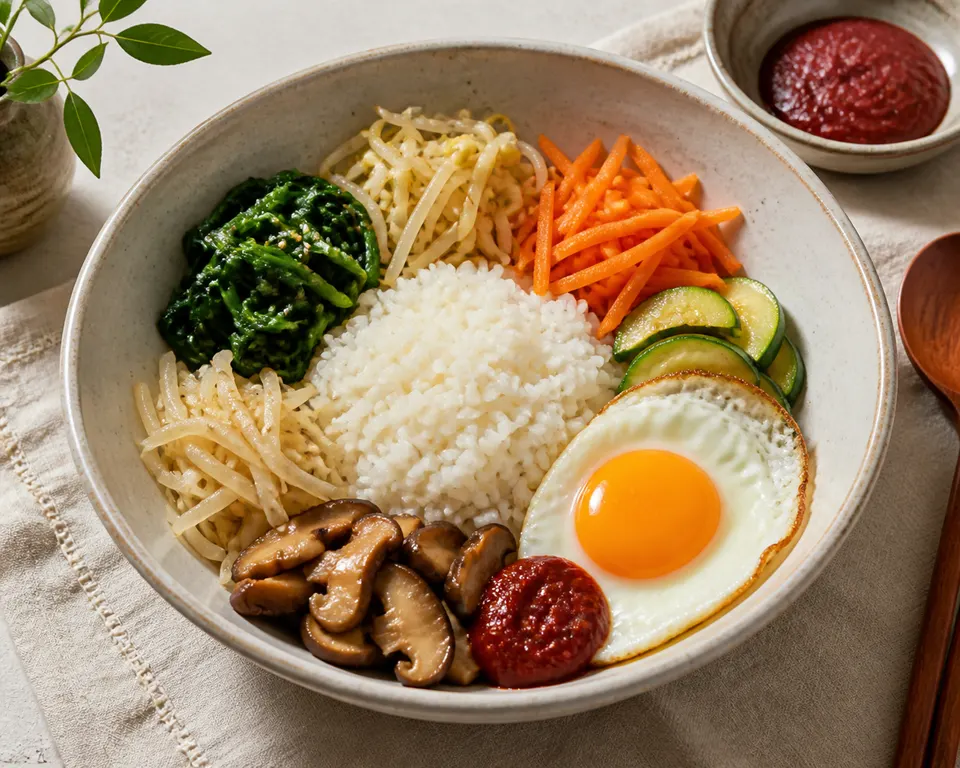
- Ask for Jeonju bibimbap or dolsot bibimbap and notice the rice, vegetable arrangement, and seasoning before mixing.
- CHECK THIS
- See whether the bowl arrives in a hot stone pot, with a raw or cooked egg, and with gochujang served separately or already included.
Source: VISITKOREA · Jeonju Bibimbap · VISITKOREA · Bibimbap and Seasonal Ingredients
SHOP THE AISLE
Shop the short list
What do you actually need for a first attempt?
- START HERE
- Buy rice, spinach, bean sprouts, carrot, zucchini, mushrooms, eggs, sesame oil, and gochujang; treat beef as optional.
- CHECK THIS
- Look for Korean gochujang in the paste aisle and choose vegetables you can cook separately without crowding the pan.
Source: VISITKOREA · Bibimbap and Seasonal Ingredients · Korea.net · Bibimbap Recipe and Preparation
COOK AT HOME
Make one controlled bowl
How can you learn the balance without making a project?
- START HERE
- Use the recipe below for two bowls, then change only the gochujang amount in the second serving.
- CHECK THIS
- Taste one bite before adding more sauce. You should still be able to identify the vegetables after mixing.
Source: Korea.net · Bibimbap Recipe and Preparation · VISITKOREA · Bibimbap and Seasonal Ingredients
RECIPE LAB
A two-bowl Jeonju-inspired bibimbap
This is a source-adapted home version, not a claim to reproduce every Jeonju restaurant recipe. Keep the components separate and let the final bowl be your adjustment point.
Adapted from Korean sources
- MAKES
- 2 bowls
- PREP
- 25 minutes
- COOK
- 25 minutes
Key ingredients
- 2 cups cooked short-grain rice
- 4 oz baby spinach
- 4 oz bean sprouts
- 1 medium carrot, julienned
- 1 small zucchini, thinly sliced
- 4 oz shiitake mushrooms, sliced
- 2 eggs
- 2–4 teaspoons gochujang
- 2 teaspoons sesame oil
Method
- 01
Make the rice
Cook the rice and keep it warm while you prepare the vegetables.
- 02
Cook the greens and sprouts
Blanch spinach and bean sprouts briefly, drain well, and season each in its own bowl with a little salt and sesame oil.
- 03
Sauté the color
Cook carrot, zucchini, and mushrooms separately in a lightly oiled pan until just tender. Keep their textures distinct.
- 04
Fry the eggs
Fry two eggs to your preferred doneness. A set white with a soft yolk gives the final mix richness without requiring extra sauce.
- 05
Assemble
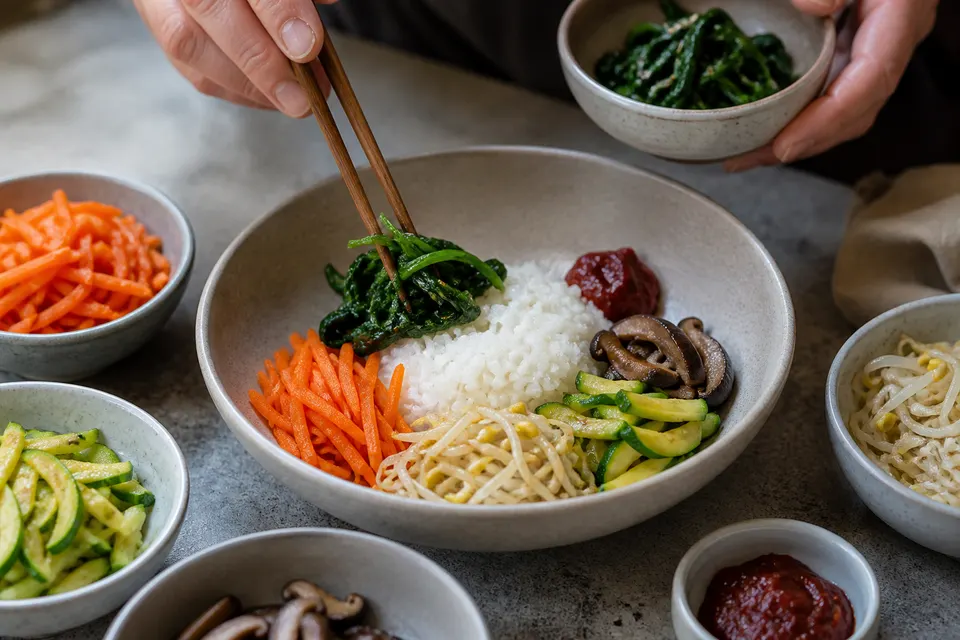
Divide the rice between two wide bowls and arrange the vegetables around it. Add one egg, one teaspoon of gochujang, and one teaspoon of sesame oil to each bowl.
- 06
Mix and adjust
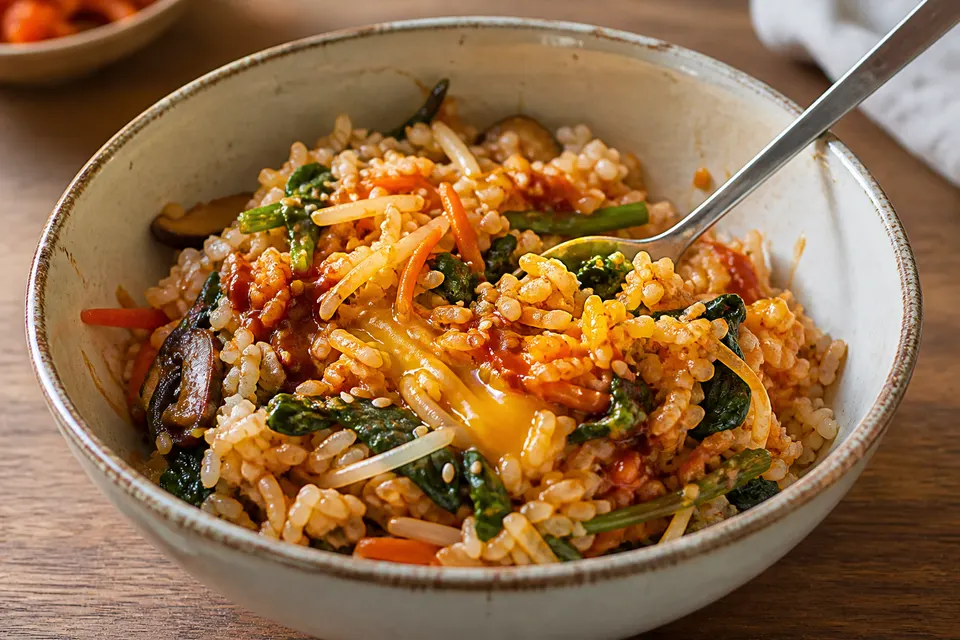
Break the egg into the rice, mix from the bottom up, taste, and add more gochujang only if the bowl needs more heat or seasoning.
Make it work with what you have
- No Korean grocery nearby
Use short-grain rice, baby spinach, ordinary bean sprouts, and a Korean gochujang available from an international aisle or online grocery.
- Want more protein
Add thinly sliced cooked beef, tofu, or a second egg without changing the vegetable seasoning.
- Prefer less heat
Start with half a teaspoon of gochujang per bowl and add sesame oil or extra rice after tasting.
Store rice and vegetables separately in the refrigerator and assemble only what you plan to eat. Reheat leftovers thoroughly and keep the egg choice aligned with your local food-safety guidance.
Source: VISITKOREA · Jeonju Bibimbap · VISITKOREA · Bibimbap and Seasonal Ingredients · Korea.net · Bibimbap Recipe and Preparation
What makes this a Jeonju-style starting point
Bibimbap literally points to mixed rice, but the name does not mean every ingredient should be cooked together from the start. Jeonju's version is known for a colorful spread of rice, vegetables, egg, and seasoning. Korean government and tourism sources connect the dish with Jeonju and describe a bowl built from fresh or seasoned ingredients rather than one uniform stir-fry. That distinction is the useful part for a first home attempt.
Think of the bowl as a small tasting menu arranged around rice. Each vegetable brings a different texture and a slightly different seasoning. The final mix is where they become bibimbap, but keeping them separate first lets you notice what you actually like. It also makes leftovers easier to rescue: a bland bean sprout, an over-soft zucchini, or a too-hot sauce can be adjusted without taking down the entire bowl.
Shop a practical vegetable lineup
Traditional descriptions can run long, with ingredients such as bean sprouts, spinach, carrots, zucchini, mushrooms, bellflower root, and other seasonal vegetables. You do not need to buy every possible topping to understand the bowl. For two servings, choose four vegetables with different jobs: one leafy green, one crisp sprout, one bright vegetable, and one savory mushroom. Add egg, rice, sesame oil, and gochujang. Beef is optional, not a requirement for the dish to work.
A Korean grocery makes the regional vocabulary easier to follow, but a regular supermarket can cover the basic structure. Use baby spinach for the green, bean sprouts for crunch, carrots for sweetness and color, zucchini for tenderness, and shiitake mushrooms for depth. If you find Korean radish or bellflower root, add it as a fifth component. The goal is contrast, not a shopping cart full of ingredients that all need their own complicated recipe.
Cook and season each part lightly
The most important home-cooking move is the least dramatic one: do not season the whole bowl with one sauce before you taste it. Blanch or sauté the vegetables separately, drain them well, and give each one a small amount of salt, sesame oil, garlic, or sesame seeds. The exact seasoning can stay simple. You are building a set of accents for the rice, not trying to make each vegetable taste finished on its own.
Korea.net's recipe guidance uses a familiar mix of rice, vegetables, egg, beef, gochujang, and sesame oil, while VISITKOREA's regional descriptions emphasize fresh and seasonal ingredients. Taken together, those sources support a flexible method rather than a single mandatory list. If you are cooking for people with different heat preferences, keep the gochujang out of the vegetable pans and let everyone control the bowl at the table.
Source: VISITKOREA · Bibimbap and Seasonal Ingredients · Korea.net · Bibimbap Recipe and Preparation
Build the bowl so every color stays visible
Put warm rice in the center of a wide bowl. Arrange the vegetables in separate sections around it, alternating colors where you can. Add the egg near the top and place gochujang on the side or in a small pocket on the rice. Finish with a few drops of sesame oil. This is not restaurant theater. The arrangement gives you a last chance to see whether the bowl is balanced before the components disappear into one mix.
If you are using a stone bowl, the vessel changes the experience by keeping the rice hot and encouraging a browned bottom. A regular bowl is a better first experiment because it makes the ingredient and sauce decisions easier to control. The source descriptions support both the visual variety of the dish and the role of rice, vegetables, egg, and gochujang; the choice of vessel is your practical decision for the kitchen you have.
BUILD, THEN MIX
The five-move bibimbap sequence
The bowl gets easier when the cooking and the eating have separate stages.
- 01
01 · COOK 따로 익히기
Cook rice and vegetables separately.
- 02
02 · SEASON 간하기
Keep each vegetable lightly seasoned.
- 03
03 · ARRANGE 담기
Place the colors around warm rice.
- 04
04 · ADD 넣기
Add egg, gochujang, and sesame oil.
- 05
05 · MIX 비비기
Mix at the table and adjust after tasting.
Source: Korea.net · Bibimbap Recipe and Preparation · VISITKOREA · Jeonju Bibimbap
Mix only after you taste the first bite
Start by breaking the egg into the rice and folding the ingredients from the bottom up. Add a small spoonful of gochujang, mix again, and taste. You are looking for a bowl where the paste seasons the rice without erasing the vegetables. Add sesame oil at the end if the bowl needs aroma rather than more salt or heat. A little water or extra rice can soften a mix that has gone too far in the spicy direction.
This sequence also explains why bibimbap can feel different from one restaurant to another. The same broad ingredients can be cut, cooked, seasoned, and mixed in different ways. Do not chase a single correct shade of red or a perfectly uniform texture. A good first bowl still has moments of crunch, softness, nuttiness, and heat. The point of mixing is to connect the parts, not to make them indistinguishable.
Source: Korea.net · Bibimbap Recipe and Preparation · VISITKOREA · Bibimbap and Seasonal Ingredients
What to notice when you eat it in Korea
In Jeonju, the useful comparison is not whether the restaurant bowl looks exactly like your home bowl. Notice what the restaurant treats as essential: the rice, the vegetable arrangement, the egg, the sauce, and the vessel. Some versions lean into a hot stone bowl; others emphasize the ingredients and the regional identity. Ask what is already seasoned and what is meant to be mixed at the table.
Korea's official food-tourism material places Jeonju bibimbap among regional specialties, but a regional label is not a promise that every restaurant uses one fixed recipe. Menus change, seasonal ingredients change, and restaurants have their own approach. The best question is specific: what is the house version, and should the gochujang go in all at once? That gets you more useful information than asking whether it is authentic in the abstract.
Your second bowl should change one thing
Once you have made the base version, keep the rice and vegetables the same and change one variable. Try less gochujang for a cleaner vegetable-forward bowl, more sesame oil for aroma, a fried egg with crisp edges, or a small amount of beef for a fuller meal. Do not change the sauce, protein, vessel, and vegetables at the same time. You want to know which choice actually improved your bowl.
That small experiment is the deeper lesson in bibimbap. The dish looks generous because it holds many components, but the cooking is easier when each component has a clear role. Arrange first, mix later, and let the person eating decide the final balance. A bowl that leaves room for adjustment is more useful than a rigid recipe that assumes every kitchen, palate, and season is the same.
Watch the Jeonju bowl before you make yours
A related on-location video is useful here for one reason: it shows the meal as an experience in Jeonju rather than pretending that a home adaptation is the same as a restaurant visit. Watch the bowl, the setting, and the way the meal fits into a day in the city. Then return to the recipe with a clearer sense of what your home version can—and cannot—reproduce.
The video is a visual companion, not proof of the regional facts in this article. Those claims stay tied to the Korean official sources in the receipts below. Use the clip to notice atmosphere and serving context, then use the recipe to make a manageable bowl with the tools and ingredients you actually have.
Source: YouTube · The Ultimate Korean Bibimbap and Attractions in Jeonju