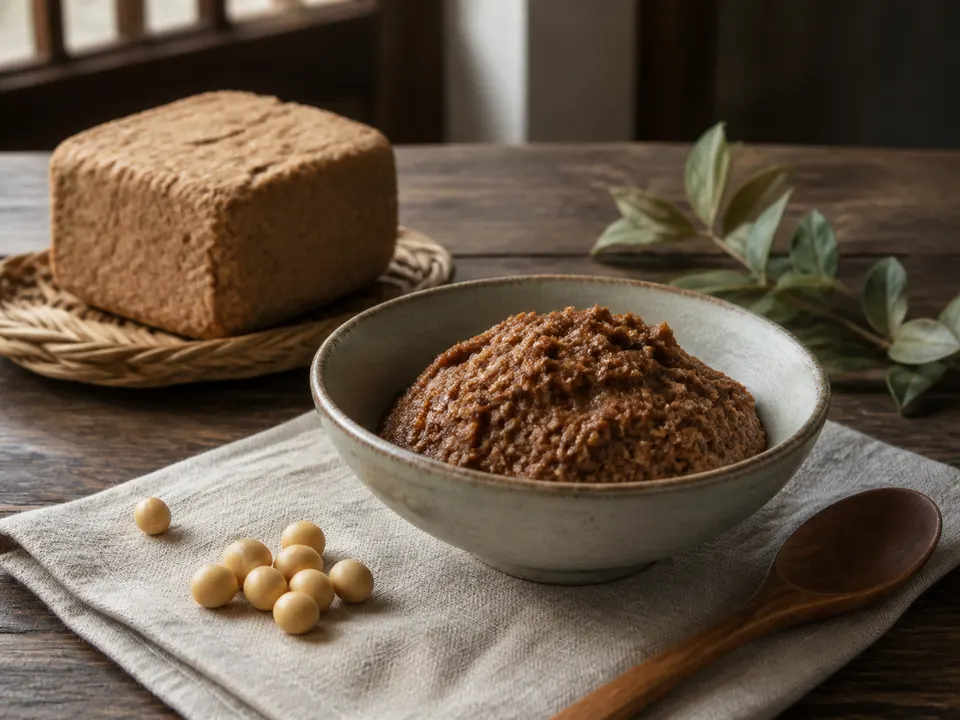
Doenjang is a Korean fermented soybean paste made from meju, salt, and time. Meju is a block of cooked soybeans that is shaped, dried, and fermented before it is immersed in brine. In the traditional process, the liquid is later separated as soy sauce, while the remaining solids are seasoned and matured into doenjang. That is why the paste tastes less like a single seasoning than like a concentrated record of beans, salt, fermentation, and aging.
The simplest way to understand doenjang is to start with its job in a Korean kitchen. It seasons soups and stews, adds depth to vegetables, and can be mixed into sauces. A small spoonful can bring salt, savoriness, and a rounded fermented aroma to a dish. For someone encountering it in an overseas grocery store, the important point is that doenjang is not just a Korean version of a generic bean paste. Its texture, salt level, roast-like notes, and sharpness can vary by product and by how it is used.
The process begins with soybeans. The Rural Development Administration describes a traditional jang workflow that moves from selecting and washing the beans to soaking, steaming, shaping, drying, and fermenting meju. The fermented blocks are then immersed in brine. After the first fermentation, the solids and liquid are separated: the liquid becomes a form of soy sauce, and the solids become the base for doenjang. The sequence matters because the paste is not made by simply blending cooked beans with salt at the end; its character develops across several stages.
Korean food references describe more than one way to make doenjang. The Korean Studies encyclopedia defines the classic form as the solids left after meju has been fermented in brine and the liquid has been drawn off. It also records a version in which the liquid is not separated, producing a paste-only jang. In other words, “doenjang” names a family of related preparations rather than one perfectly standardized texture. Industrial products and household batches can therefore behave differently in a pot or mixing bowl.
Fermentation also explains why doenjang should be treated as a living process rather than a quick recipe shortcut. In its traditional jang guidance, the Rural Development Administration discusses temperature, cleanliness, brine coverage, mold control, maturation, testing, and storage. The guidance is for controlled traditional production, not a promise that every jar follows the same timetable. For a reader, the practical lesson is more modest: look at the product label, keep the paste stored as directed, and do not assume that a strong smell alone tells you whether a product is safe or unsafe.
One technical note hosted by the Rural Development Administration reports that the length of time meju sits in brine affects quality. It recommends keeping the soaking period within 50 days for high-quality traditional doenjang and warns that excessively long soaking can move flavor and quality indicators in an unfavorable direction. This is useful context for understanding why makers talk about timing, but it should not be turned into a universal home-fermentation instruction. Conditions, recipes, vessels, and safety controls all matter.
So how should you use doenjang? Start with dishes where its depth has room to show. Doenjang jjigae is the familiar example: the paste seasons a broth that can carry tofu, vegetables, mushrooms, seafood, or meat. It can also be loosened with a little water or another sauce and used with raw or blanched vegetables. Add it gradually. The goal is not to make every dish taste intensely fermented; it is to give the dish a savory base that supports the ingredients around it.
When reading a Korean menu, 된장찌개 (doenjang jjigae) means a stew built around the paste, while 된장 (doenjang) on its own may describe the seasoning or the ingredient. The word 장 (jang) is the broader clue: it points to Korea’s family of traditional fermented sauces and pastes, including soy sauce and red pepper paste. You do not need to memorize every category before trying the food. Knowing that doenjang is a fermented soybean paste is enough to make the menu less mysterious and your first order more informed.
The short answer is this: doenjang is a Korean fermented soybean paste made through a meju-and-brine process; it is closely connected to soy sauce because both can come from the same fermentation; and its flavor is best understood through time, salt, and the way it is used in a dish. If you are buying it for the first time, choose a product with clear labeling, begin with a small amount, and treat the paste as a foundational seasoning rather than a finishing condiment.